My Camponotus rufipes has layed some eggs, and I think it is time to put her in a bigger place. I say this because right now she is between two pieces of cardboard paper inside a small pot, and the cotton pieces in the pot have started to develop mold because I am not able to clean them properly (she is overly aggressive and very easily stressed, so I have avoided moving her so far).
quarta-feira, 16 de novembro de 2011
terça-feira, 8 de novembro de 2011
New nest idea
I recently came up with an idea for a mixed sand/loam and plaster nest. I put a colony of Pachycondyla striata in it to "test". The result looks quite good.
I first created a bit of plaster on one side of the shoe box, as so:
Then I put sand in and a little bit of loam on top (they can't dig in the sand, but can dig in the loam, and I did not want them digging but using the bit of plaster as nest instead). They are using one of the far side corners as rubbish dump:
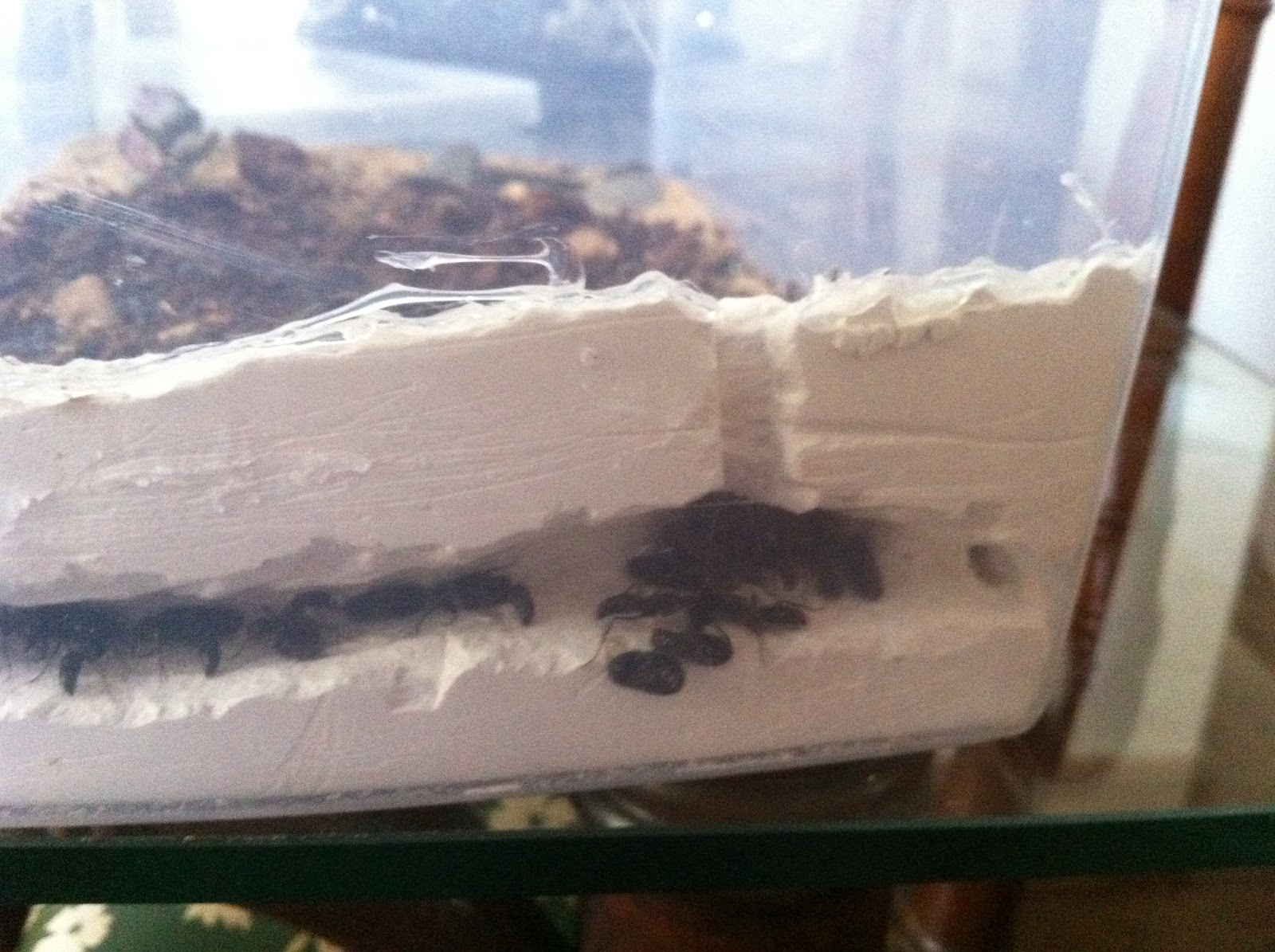
On the bit of plaster I excavated a side chamber and also some underground chambers. As soon as I put the ants in, they proceeded to move the brood inside the plaster almost straight away. You can see the side here:
I made a mistake, however. I glued the top with silicon but I did not glue the bottom with anything. So the plaster lifted a little bit when I picked up the nest for the first time, and this created some space at the side and underneath. Sand went in and kind of flooded the underground chambers, and although the ants took the sand out, it is impossible to see what is going on underneath (and also there is an ugly space between the plaster and back wall. Something I will have to remedy somehow.
Marcadores:
Nest
Eggs :)
My Camponotus rufipes queen has finally layed eggs. They cannot be seen from these pictures, but she has a small clump of eggs with her. I am thinking about putting her in a setup with some wood. I will have to think about it.
Meanwhile, she is between two small slices of cardboard paper to mimic wood. It seems she is ok there, she chewed a bit of cardboard to make a small entrance hole and also to shape some "furniture" :D
Marcadores:
Camponotus rufipes
quarta-feira, 2 de novembro de 2011
New home
This morning I put two of the four Formica fusca queens in their new home. I opened the hoses they were in on one end and left them. So far they have chosen not to come out yet, let's see if they will be out by the time I get back home. Here is their setup:
I hope they can become co-rulers and the colony will thrive.
Marcadores:
Formica fusca
terça-feira, 1 de novembro de 2011
segunda-feira, 31 de outubro de 2011
New Pachycondyla striata queens
Yesterday I was able to go into the woods and I was fortunate to collect a few Pachycondylas which I believe to be Pachycondyla striata. I collected three solitary female alates, a group of two and a group of four. This is a picture with one of the alates:
I put the group of four in a big plastic shoebox:
They quickly settled in and around a small "house" I built for them of damp cotton wool and a piece of cardboard on top.
I put the group of four in a big plastic shoebox:
They quickly settled in and around a small "house" I built for them of damp cotton wool and a piece of cardboard on top.
Marcadores:
Pachycondyla striata
sexta-feira, 28 de outubro de 2011
Pachycondyla striata queen?
I was coming back from dinner where I work and I saw this huge Pachycondyla walking on the curb alongside the road. Luckily one of my colleagues had a plastic cup and the ant was really happy to go in there because of the Coke drops still in the cup.
I believe it is a queen of Pachycondyla striata (same species as the other I have which is not a queen) because this one is bigger and has scars indicating wings were probably there in the past. Let's wait and see if it will start laying eggs.
Look at how big it is compared to the Lenovo mouse:
Here is a short video of it. I believe the wing scars can be seen (if they are indeed wing scars).
Marcadores:
Pachycondyla striata
Cleaning up the tube
Well, the test tube was broken and there were so many loose shards inside that I decided the best course of action would be to try and clean it as gently as possible without disturbing the ants. After a small brain-surgery-like operation, the test tube was free of shards (only a very small one which seems to be tangled in the cotton remains. I would not be able to remove it without disturbing the ants directly so I chose to leave it as it is very small), and the cotton wool was dipped in water and squeezed so to make it humid again and put back. I'm quite happy with their new shelter until I get home. :)
Marcadores:
Lasius flavus
Second one from Europe
Today my Lasius flavus arrived from England. It was posted on the 6th October, today is the 28th. She is alive an well, but it was a fluke because the test tube she arrived in is completely smashed in the middle. The bubble wrap is keeping it together. She has around 5 workers with her but they are so tiny I could not take better pictures right now. This is the test tube she arrived in (not much to see, really, as it still has bubble wrap all around):
She seems to be unhurt and the workers are fine, moving about and grooming themselves now and then. She is moving as well and grooming herself quite often. When I get home I will transfer her to the sand nest I have for her and will try to take some pictures. I don't want to open the bubble wrap right now as I am at work and the tube will definitely come apart. I hope she is not too stressed, she is very small but looks really nice :)
Marcadores:
Lasius flavus
New eggs
My Pachycondyla has been having a lot of protein lately (insects) and has two eggs. She had another one but it vanished (I think she might have eaten it, but I'm not sure. They are so small and difficult to see that maybe she had stored it somewhere and I hadn't noticed). Anyway, yesteday I was looking at her feeding and noticed she was carrying something which looked like an egg between her mandibles. When I looked closer I was pretty happy to see not one but two :)
She is storing them in one of the chamber in her plaster nest. They are very small, but I believe you will be able to see them in the pictures.
They are the dirty yellow things, on the first pictures they are bundled together and on the last ones they are separate, close to each other.
She is storing them in one of the chamber in her plaster nest. They are very small, but I believe you will be able to see them in the pictures.
They are the dirty yellow things, on the first pictures they are bundled together and on the last ones they are separate, close to each other.
Marcadores:
Pachycondyla striata
Camponotus rufipes
I was in my mother's garden doing some gardening (!) for her and I kicked a piece of rotting branch which was still attached to one of the shrubs and noticed straight away something big scurrying in the grass. I went to look and saw it was a young queen (the very first queen I found in the wild by myself).
It had its wings off already, but I could not find any brood in the wood or on the floor. If there was any, It's gone. No workers either.
I put her in a small plastic pot and tried to feed her some insects, but she has not eaten anything so far.
I am leaving her alone for now and checking on her once a day. I hope she has been fertilized, but she has not layed any eggs so far either. She has water and a honey drop with her.
Marcadores:
Camponotus rufipes
Assinar:
Postagens (Atom)